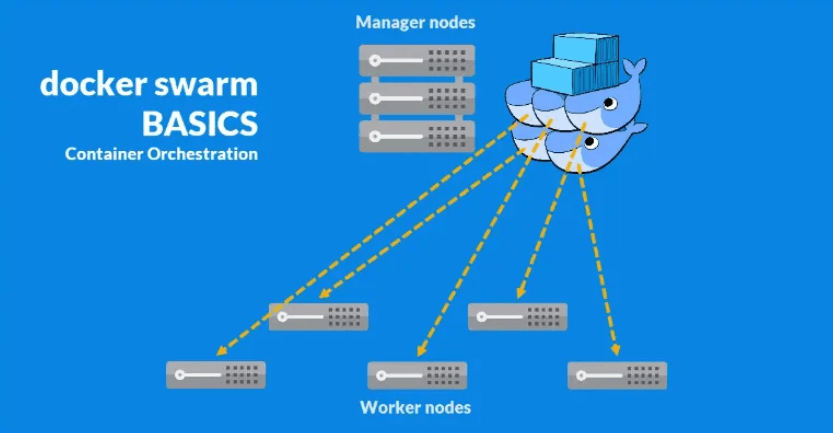
Distributed Resilience: Orchestrating Containers with Docker Swarm
Step into the world of multi-node container orchestration. This guide provides a foundational architectural review of Docker Swarm from cluster initialization and worker node integration to service scaling and automated updates in a distributed environment
Docker Swarm is a high-performance clustering and orchestration tool designed to manage and scale containers across a distributed network of nodes. Unlike standalone Docker instances, a Swarm transforms a collection of machines into a single, virtualized compute resource.
In this guide, we dive into the foundational steps required to initialize a cluster, manage worker nodes, and orchestrate services at scale.
Prerequisites
Before architecting the swarm, ensure your environment meets these technical requirements:
- Standard proficiency in Docker core concepts and CLI commands.
- A minimum of three machines (virtual or physical) with Docker installed.
- Network topology: One machine designated as the Manager Node and two as Worker Nodes.
Phase 1: Initializing the Cluster Architecture
The first step is to establish the Manager Node, which acts as the brain of the cluster, handling scheduling and state management.
-
Initialize the Swarm on the Manager:
-
Integrate Worker Nodes: On each designated worker node, execute the join command provided by the manager. This registers the node into the cluster's internal gossip network.
-
Verify Cluster Integrity: From the manager node, audit the current state of all nodes in the swarm:
Phase 2: Service Orchestration and Lifecycle Management
In Docker Swarm, we manage Services rather than individual containers. Services allow us to define the "desired state" of our application across the entire cluster.
Deploying a Service
Create a globally accessible Nginx service with three redundant replicas:
Auditing Active Services Generate a high-level summary of all orchestrations:
Horizontal Scaling
Scale the application to five replicas instantly to handle increased traffic:
Rolling Updates
Update the service image to the latest version without downtime:
Architectural Inspection
Examine the detailed JSON metadata of a specific service:
Resource Termination
Completely remove the service and its associated tasks from the cluster:
Conclusion
Docker Swarm provides a lightweight yet resilient solution for orchestrating containers in a distributed environment. By abstracting multiple nodes into a single logical unit, it empowers engineers to build applications that are both scalable and fault-tolerant.
For a deeper exploration, consider researching advanced features such as Rolling Update Policies, Service Rollbacks, and Node Constraints.
Technical References
Official Docker Swarm Documentation
Docker Engine Core Documentation
Happy Orchestrating!
Fuel the Architecture
If this deep dive helped you build something better, consider fueling my next late-night coding session.
Newsletter Updates
Join 1,000+ engineers receiving weekly insights into AI, cloud architecture, and technical guides.